Let Students Choose Their Paths


Dear Dr. Louis,
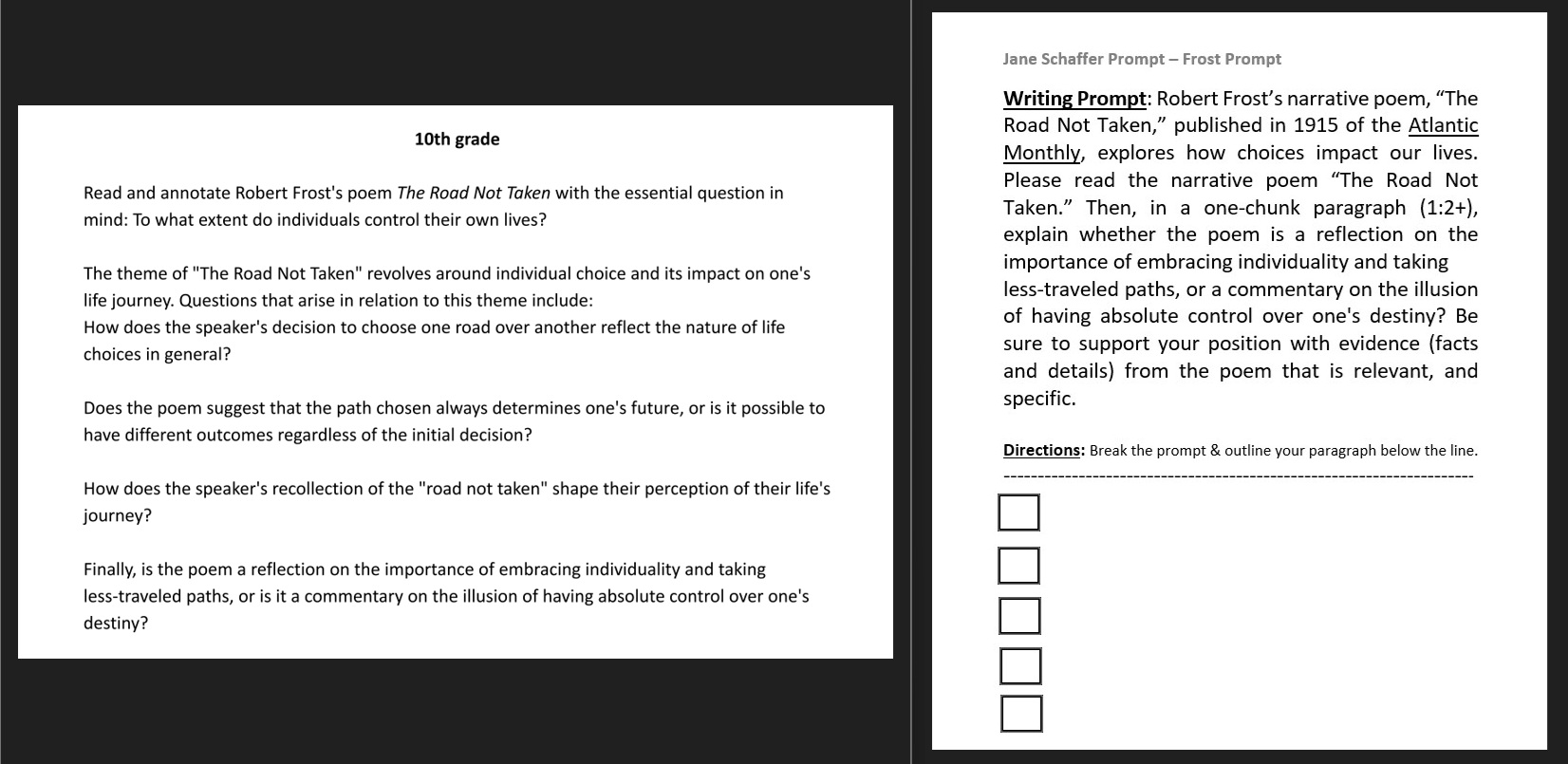
I was looking at the 10th Grade PLC (Professional Learning Community) prompt that my team developed while I was out, and I found it to be not clear enough for students to be able to tackle and answer. I am attaching it in this email. It just seems like a series of questions -- too many.
Our students are struggling readers and writers, and I feel this prompt might be difficult for them to answer with evidence. What do you think?
Thank you in advance,
Georgia P.
Dear Ms. P,
- The 10th grade prompt has wonderful questions to consider. Here are my comments and concerns responding to the prompts below and regarding effective prompt writing:
- What's the scope of the assignment?
- Essay? Should there be an introduction and conclusion? Unclear.
- The first set of prompts appear more like constructed responses than an essay, and many of the questions are redundant. This set of prompts hopes that students will consider all of the questions and organize their answers in a thoughtful response, which is a critical organizational skill that may prove to be difficult for fifteen-year-olds to do well without your guidance.
- The repetition might be intentional, because sometimes we come at a question in multiple ways for students to answer.
- But with the questions being listed, be prepared for students to answer the questions in order with lots of redundancy, too.
- The theme prompt. IMPORTANT FOR TEACHING LITERATURE: I talk to teachers about the importance of "not giving the students the theme."
- First, there are multiple themes in literary works and this poem is no exception, the most obvious of which is an "individual's choice."
- Allow the students to derive a theme that resonates with a lesson they learned from reading the text. You might be surprised what they derive. Otherwise, they'll be repeating your prompt and an "individual's choice," ad nauseum.
- Bullets #3 and #5 are either/or questions.
- First, avoid questions in a prompt because students hone in to the question without paying attention to the nuances surrounding the question.
- In all of the bulleted prompts, simply turn the question into a declarative sentence: replace "How does the speaker's decision . . ." with "Explain how the speaker's decision . . ."
- Secondly, literature has so many possibilities; we don't want to tell the students what to think with an either/or question. I tell students, "You may have your own interpretation as long as you can support it with evidence from the text." Poetry and the gift of the beholder . . .
- First, avoid questions in a prompt because students hone in to the question without paying attention to the nuances surrounding the question.
- The second graphic, which is your prompt, is beautifully written. Here are my comments and concerns:
- Your prompt is an argument because you're asking them to take a position.
- But the positions you're asking them to choose can no way be done in a one-chunk paragraph. "Illusion of having absolute control over one's destiny" vs "Control over one's destiny" in a one-chunk paragraph? No way. This needs to be an essay.
- In 10th grade, if you have taught argumentation, students should be able to provide a concession, a counterargument, and a refutation.
- I like your prompt for a multi-paragraph essay.
- If you want a one-chunk paragraph, present some relevant quotes from the text, and let each student choose his/her favorite:
- In a one-chunk paragraph (1:2+), analyze what is meant by one of the following quotes. For your commentary sentences, be sure to analyze the speaker's attitude and what the quote means to the speaker's journey. For your concluding sentence, ponder how the quote relates to life with a thematic statement.
- "And sorry I could not travel both/And be one traveler . . . "
- "looked down one as far as I could/To where it bent in the undergrowth;/Then took the other, as just as fair . . ."
- ". . . the passing there had worn them really about the same . . . "
- "Yet knowing how way leads on to way/I doubted if I should ever come back."
- ". . . telling this with a sigh/Somwhere ages and ages hence . . ."
- Then, put the students in groups and let them share their wiggles!
- In a one-chunk paragraph (1:2+), analyze what is meant by one of the following quotes. For your commentary sentences, be sure to analyze the speaker's attitude and what the quote means to the speaker's journey. For your concluding sentence, ponder how the quote relates to life with a thematic statement.
Keep Reading and Writing!
Warm regards,
Dr. Louis